Regionen und Verfügbarkeitszonen
Zuletzt aktualisiert am
Was ist eine Region?
Abschnitt betitelt „Was ist eine Region?“Eine Region zeichnet sich dadurch aus, dass sie physisch vollständig von anderen Regionen getrennt ist. Jede Region besteht aus drei oder mehr Verfügbarkeitszonen, wobei drei AZs die Regel sind. Darüber hinaus wird sichergestellt, dass sich alle AZs einer Region immer im selben Land befinden, d. h. eine Region ist immer länderspezifisch.
Die Funktionsweise der verschiedenen Produkte ist über ihre Region definiert, sodass Sie in allen AZs in dieser Region jeweils über den gleichen Funktionsumfang verfügen können.
Technisch ist sichergestellt, dass zwischen den einzelnen AZs einer Region eine Bandbreite von mindestens 200 GBit/s mit einer Latenz von circa 0,5 ms besteht. WAN-Verbindungen terminieren ebenfalls in jeweils einer Region.
Derzeit bieten wir die Region „Heilbronn/Deutschland“ an. Sie trägt die Bezeichnung „eu01“.
Was ist eine Verfügbarkeitszone (AZ)?
Abschnitt betitelt „Was ist eine Verfügbarkeitszone (AZ)?“Jede Verfügbarkeitszone (AZ) kann genau einer Region zugeordnet werden und ist logisch mit dieser Region verknüpft.
Eine AZ zeichnet sich dadurch aus, dass Stromversorgung, Kühlung und lokale Netzwerkverbindungen jeweils vollständig von allen anderen AZs getrennt sind.
Es gibt 3 physische Umsetzungen für eine AZ:
- Eine AZ entspricht einem Rechenzentrum, wenn die oben genannten Anforderungen erfüllt sind.
- Eine AZ wird logisch über mehrere Rechenzentren gespannt, wenn die oben genannten Anforderungen erfüllt sind.
- Mehrere AZs können in einem Rechenzentrum betrieben werden, wenn die oben genannten Anforderungen erfüllt sind und zudem sichergestellt ist, dass die verschiedenen AZs in unterschiedlichen Brandabschnitten betrieben werden können.
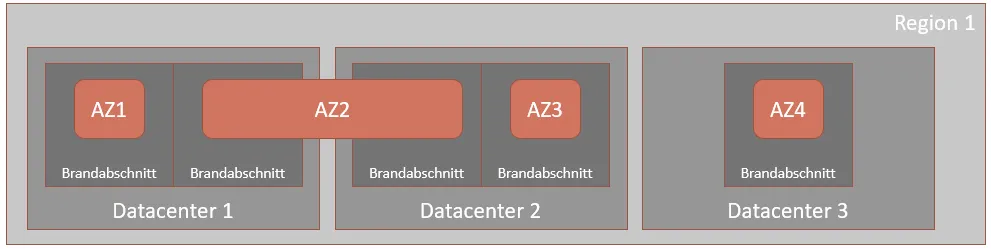
Das obige Diagramm zeigt mögliche Ausprägungen einer Verfügbarkeitszone und bildet die Grundlage für die tatsächlichen Verfügbarkeitszonen.
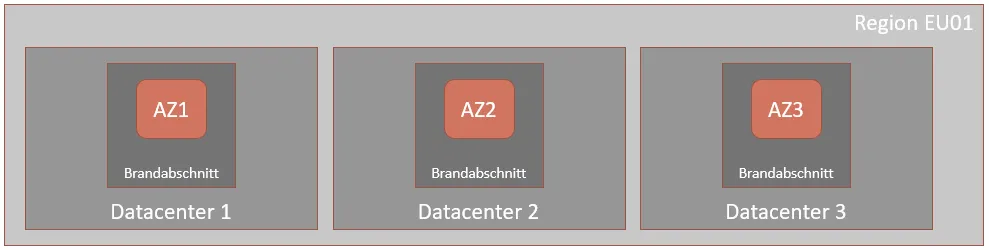
Das folgende Diagramm zeigt das tatsächliche Layout der Region EU01:
Verfügbarkeit
Abschnitt betitelt „Verfügbarkeit“Metro-Verfügbarkeitszone
Abschnitt betitelt „Metro-Verfügbarkeitszone“Volumes, die dem Bereich „Metro“ zugeordnet sind (z. B. wenn die VM in diesem Kontext betrieben wird), befinden sich auf einem Metro-Storage-Cluster, der über zwei verschiedene Rechenzentrumsstandorte gespiegelt wird. Der Metro-Cluster ist über beide Rechenzentren voll verfügbar. Dies bedeutet im Ergebnis, dass eine komplette AZ offline sein könnte und die Daten ohne Funktionseinschränkungen weiterhin verfügbar wären.
Single-Verfügbarkeitszone
Abschnitt betitelt „Single-Verfügbarkeitszone“Volumes, die dem Bereich „Single AZ“ zugeordnet sind (z. B. wenn die VM in diesem Kontext betrieben wird), befinden sich auf separaten Speichersystemen innerhalb der jeweils ausgewählten AZ.
Die Speichersysteme in allen verfügbaren AZs sind jeweils vollständig unabhängig von allen anderen AZs und mit Hochverfügbarkeits-Controllern und SSD-Speichermedien ausgestattet. Dementsprechend ist bei einer Störung einer gesamten AZ nur die jeweilige AZ von dieser Störung betroffen – ohne Auswirkungen auf die anderen Single AZs. Die Speicherdaten einer Single AZ werden nicht in eine andere AZ gespiegelt – dies kann jedoch bei Bedarf anwendungsseitig erfolgen.
Block Storage Regionen und AZs
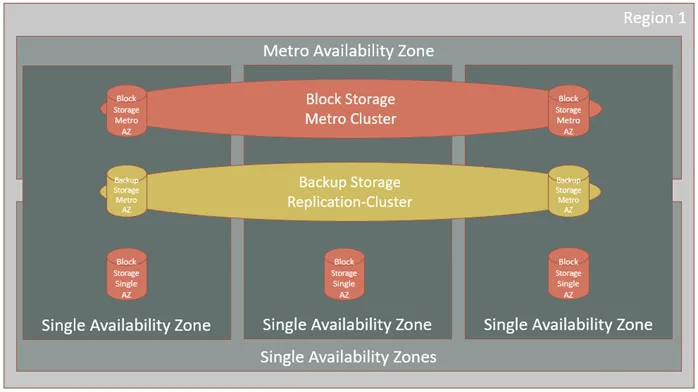
Abschnitt betitelt „Block Storage Regionen und AZs“Das folgende Diagramm zeigt den schematischen Grundaufbau der Block Storage Typen in Region 1 (z. B. eu01).
Zwischen den Single-AZ-Speichersystemen („Block Storage AZ“) findet keine Replikation statt. Die Metro-Systeme („Block Storage Metro“ und „Backup Storage Metro“) sind jeweils über verschiedene AZs gespannt.
Der STACKIT Backup Storage befindet sich auf einem Speichersystem, das physisch vom regulären STACKIT Block Storage getrennt ist. Auf diese Weise sind die Sicherungen auf dem Backup Storage besonders geschützt und unabhängig von den primären Speichersystemen.