Pricing options and invoice
Last updated on
Choosing the right pricing model is a critical factor for the success of your product in the Cloud Marketplace. It affects not only your revenue, but also the attractiveness of your offer for different customer segments. Our marketplace supports a variety of flexible pricing models to ensure you can choose the optimal model for your product and target group.
The following pricing models are available to you as a vendor:
- Subscription
- Free Trial
- Pay-as-you-go (PAYG): coming soon
- Bring Your Own License (BYOL): coming soon
- Free: coming soon
Contractual relationships
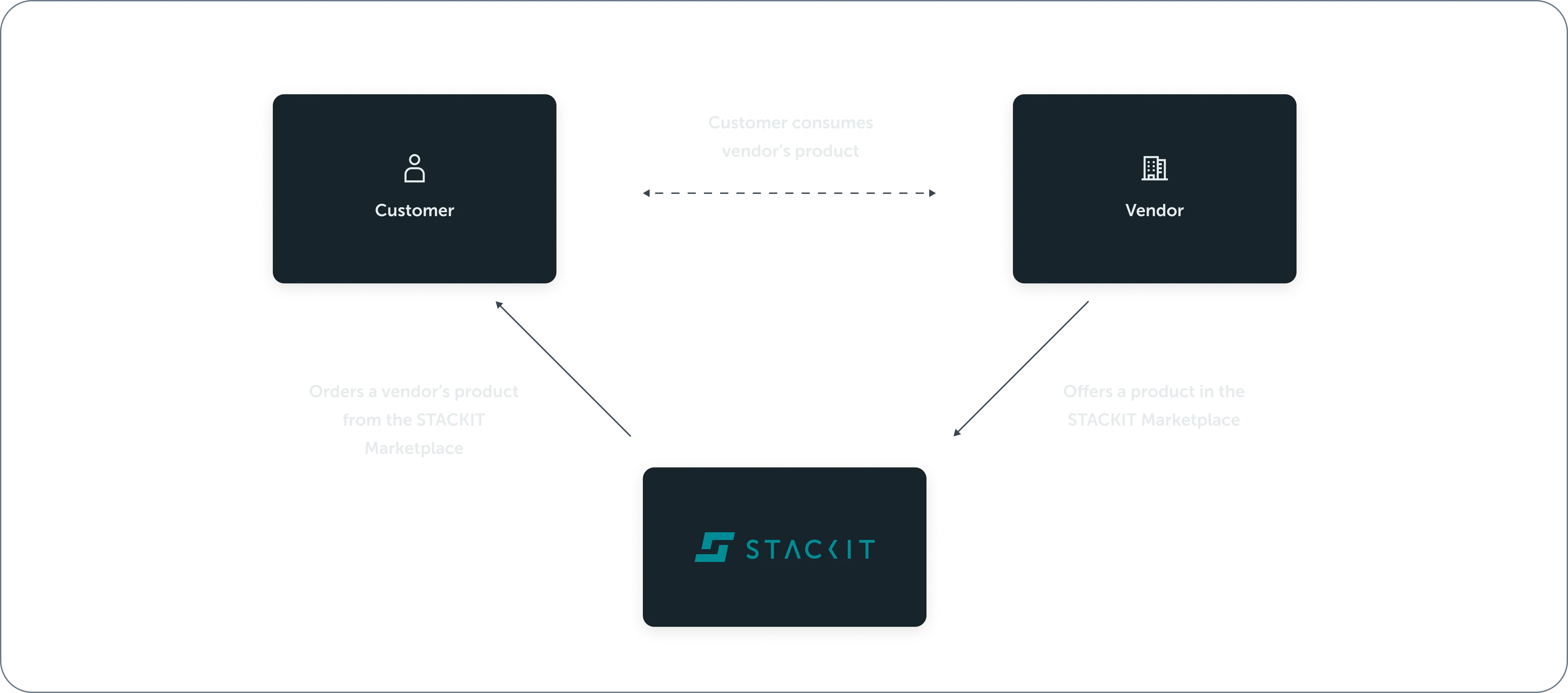
Section titled “Contractual relationships”The contracts between STACKIT and the seller are resale contracts. The following diagram shows the contract types that apply between the different parties:
Combinations of pricing models (pricing options)
Section titled “Combinations of pricing models (pricing options)”To give you even more flexibility in pricing, you can combine pricing models (or pricing options) with each other. Here are common combinations you can consider:
Dimensional pricing (time dependency)
Section titled “Dimensional pricing (time dependency)”Here, a price model is defined depending on a time unit. This is particularly relevant for usage-based models or subscriptions. This enables precise billing based on actual usage time or resource consumption over a period of time.
Examples:
- PAYG: Billing per hour, per minute, per second server runtime.
- Subscription: Fee per month, per year for access to the software.
- Data storage: price per GB per month for data storage.
Step-by-step pricing (graduated prices)
Section titled “Step-by-step pricing (graduated prices)”The price changes by leaps and bounds depending on the quantity purchased or the number of users / licenses. Often the price per unit decreases the more is purchased.
Examples:
- Licenses: “The first 10 users cost a flat rate of € 100 per month, then € 8 per month for each additional user.”
- Volume discounts: “Up to 100 GB data transfer € 0.10 per GB, from 100 GB data transfer € 0.08 per GB.”
- Graduated prices for subscriptions: “Basic subscription € 20 / month (max. 5 users), Premium subscription € 50 / month (max. 20 users), Enterprise subscription € 100 / month (unlimited users).”
Hybrid pricing
Section titled “Hybrid pricing”A combination of different basic pricing models for different aspects of your product or for different customer segments.
Examples:
- Subscription + PAYG: A basic subscription includes a certain amount of resources or usage units. Additional usage units are billed in the PAYG model. (e.g., “Subscription includes 1000 API calls per month, each additional call costs € 0.01”).
- BYOL + Subscription for Support: Customers bring their own license (BYOL), but must purchase a separate subscription for support and maintenance.
- Free Trial + Subscription: Customers start with a free trial phase and then automatically switch to a paid subscription.
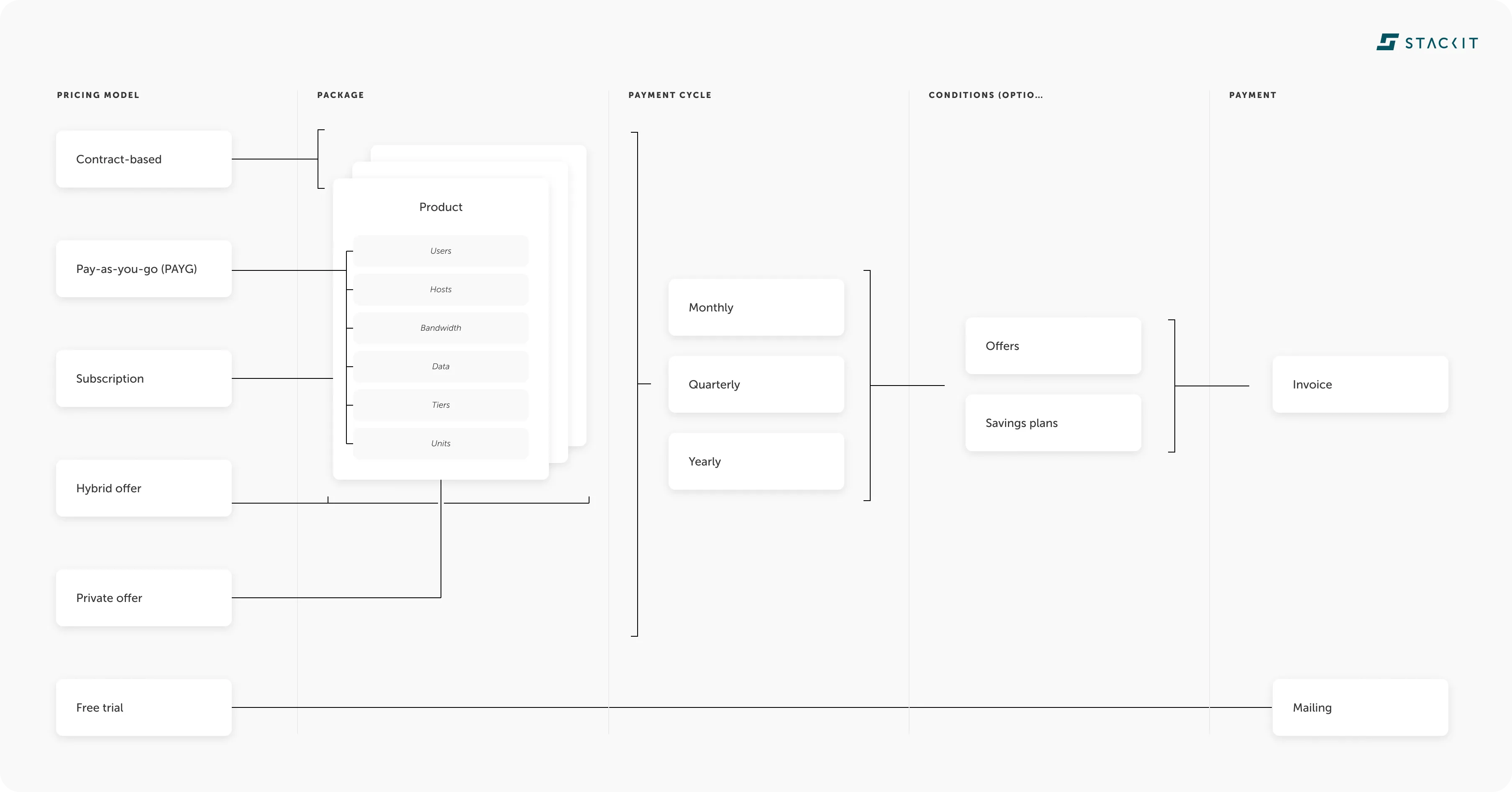
Billing with customers
Section titled “Billing with customers”Customers order your product according to your conditions. You can decide if there are special combinations of pricing models, offers, or plans for your product. The following diagram shows the billing for each price model until payment by the customer.