Create a convincing detail page
Last updated on
The product detail page is your digital shop window for your product in the STACKIT Marketplace. It is often the first point of contact for customers with your product and is a decisive factor in whether a prospective customer takes a closer look at your offer or abandons it. It is therefore crucial to present all relevant information here in an appealing and convincing way.
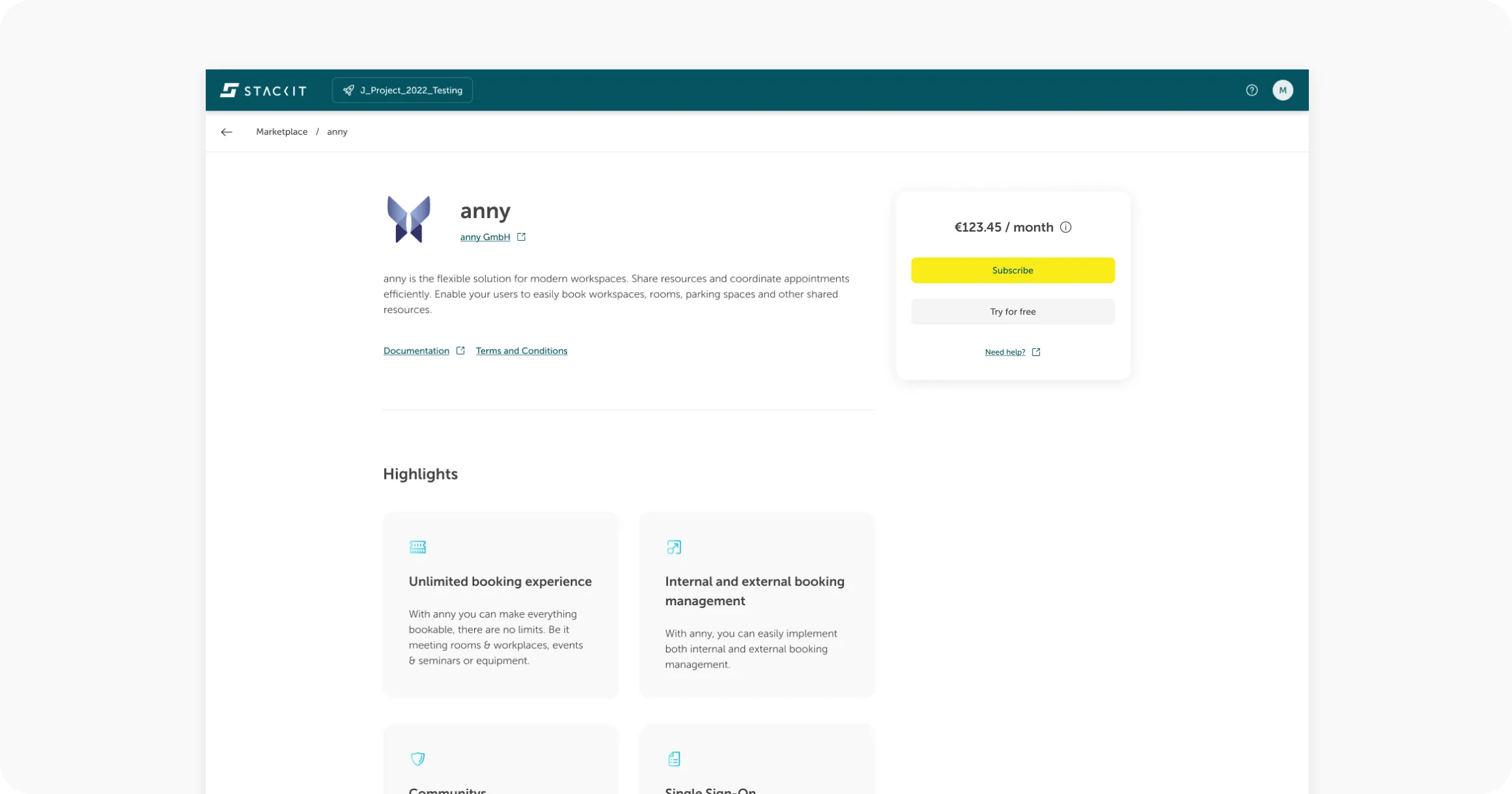
Detail page in the STACKIT Marketplace.
Product name and brief description
Section titled “Product name and brief description”The product name and short description are the first elements that customers notice about your product. They decide in a fraction of a second whether your offer is relevant for them. You should therefore design these elements with particular care:
Product name
Section titled “Product name”- Concise and clear: Choose a name that is easy to understand and clearly communicates the core of your product. Avoid internal abbreviations or highly technical jargon that potential customers won’t understand.
- Meaningful: Ideally, the name should already give an indication of the benefits or function of your product.
- Keyword-relevant: Incorporate relevant keywords that customers use when searching for solutions like yours, but make sure you use natural wording and avoid pure keyword clusters that disrupt the reading flow.
Short description
Section titled “Short description”- Captivating and attention-grabbing: Write a short, concise and interesting description that immediately arouses the reader’s curiosity.
- Emphasize core benefits: Focus on the key benefit or problem that your product solves What is the most important benefit for the customer?
- Call-to-action (implicit): Encourage them to read on! The short description should arouse interest and encourage the customer to take a look at the detailed product page.
- Note the length: Stick to the specified character limit of approx. 150-200 characters to ensure that the short description is displayed optimally in all areas of the marketplace.
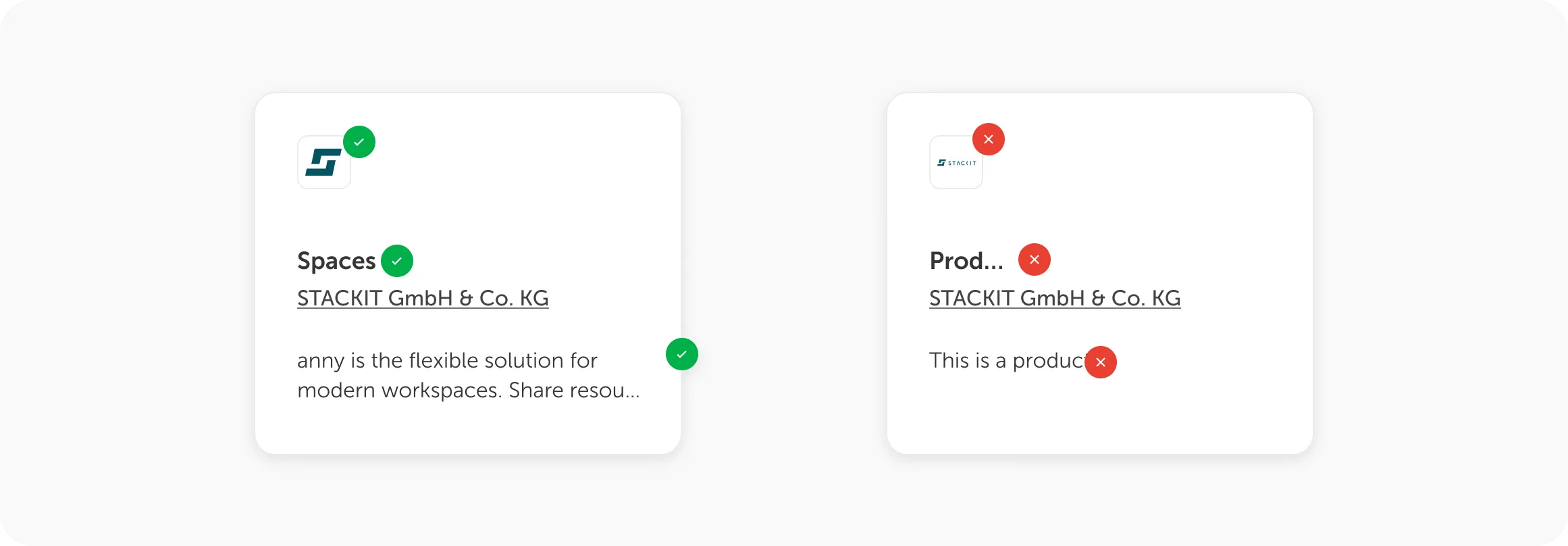
left - product tile contains a clearly visible logo and appealing, clear information, right - logo is poorly visible, labels are too generic.
Detailed product description and features
Section titled “Detailed product description and features”Once the product name and brief description have aroused interest, the detailed product description is the place to provide potential customers with comprehensive information and convince them of the qualities of your product.
Detailed and structured description
Section titled “Detailed and structured description”- Provide comprehensive information: Describe all important aspects of your product in detail. Go into detail about functions, benefits, technology, integrations and unique selling points.
- Clear structure: Organize the text in a logical and user-friendly way:
- Headings: use meaningful headings to divide the text into meaningful sections (e.g. “Core features”, “Benefits for your business”, “Technical details”, “Integrations”).
- Bullet points: Use bullet points to make lists of features, benefits or technical details concise and easy to read.
- Paragraphs: Use short, comprehensible paragraphs to explain more complex contexts or describe use cases.
- Clear and precise language: Formulate comprehensibly and without unnecessary technical jargon. Use language aimed at your target group. Avoid vague statements and use concrete descriptions.
Highlights: focus on functions
Section titled “Highlights: focus on functions”- Detailed list: List all relevant features and functions of your product in detail.
- Precise language: Describe each feature clearly and unambiguously. What exactly can the customer do with it?
- Optional grouping: If necessary, organize features thematically into groups (e.g. “security functions”, “reporting functions”, “administration functions”) to increase clarity.
Value orientation: customer benefit counts!
Section titled “Value orientation: customer benefit counts!”- Focus on benefits: Describe not only what your product can do, but above all what benefits it brings the customer. Concentrate on the advantages!
- Problem solution: Explain what specific problems your product solves for the customer. What challenges are addressed?
- Value proposition: Clearly communicate the value proposition of your product. What makes your offer unique and valuable for the customer?
Examples of customer benefits
Section titled “Examples of customer benefits”- Cost savings: Reduction of operating costs, more efficient use of resources, avoidance of downtime.
- Increased efficiency: automation of processes, acceleration of workflows, time savings.
- Improved security: Protection against data loss, cyber threats, compliance risks.
- Innovative functions: Unique features that open up competitive advantages or new opportunities.
- Scalability & flexibility: Adaptability to growing requirements, flexible use, easy integration.
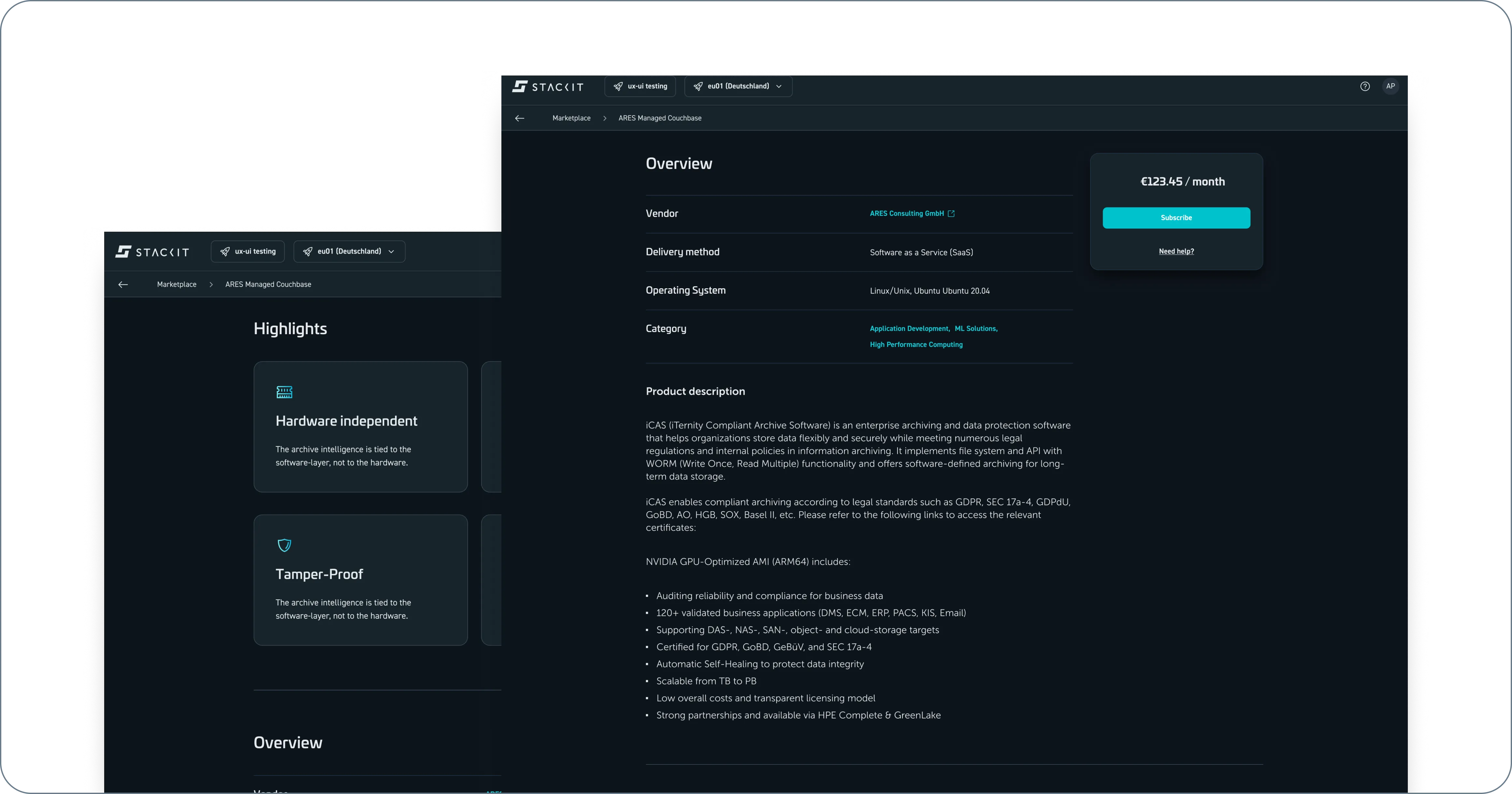
Highlights and product description of a product in the STACKIT Marketplace.
Target group and use cases
Section titled “Target group and use cases”In order to address potential customers in a targeted manner and clarify the relevance of your product, it is important to clearly define the target group and describe specific use cases.
Target group definition
Section titled “Target group definition”- Clear and precise: Define your ideal target group as precisely as possible. The clearer the target group, the better you can target your product description and marketing materials. When defining your target group, take into account relevant criteria such as
- Industries: In which industries is your product particularly relevant? (e.g. healthcare, financial services, e-commerce, manufacturing).
- Company size: For which company sizes is your product best suited? (e.g. SME, enterprise, start-ups).
- Roles/functions: Which roles or functions within a company will benefit most from your product? (e.g. IT administrators, marketing managers, sales managers, developers).
- Geographical region: Are there geographical focuses or restrictions for your offering?
- Benefit orientation: Think about the specific needs and challenges of this target group and how your product addresses them.
Use cases / application cases
Section titled “Use cases / application cases”- Concrete examples: Describe typical use cases and usage scenarios for your product. The more concretely and vividly you present the use cases, the better potential customers will be able to recognize the practical value and see themselves in these situations.
- Problem & solution: In each use case, briefly describe the initial problem or challenge and then show how your product offers the solution.
- Focus on customer benefits: Again, emphasize the benefits for the customer in each use case. What specific advantages result from the application in this scenario?
Example
Section titled “Example”Target group: Small and medium-sized enterprises (SMEs) in the e-commerce and services sector.
- Use cases:
- Automatic data backup of web stores and customer databases: reliably protect your online store and sensitive customer data from data loss due to hardware failures, human error or cyber threats. Minimize downtime and ensure business continuity.”
- Recover from ransomware threats: Prepare optimally for an emergency. In the event of a ransomware threats, you can quickly and easily restore your data from the secure cloud backup and quickly resume business operations.”
- Long-term archiving of compliance-relevant data: Meet legal retention obligations and archive compliance-relevant data in the cloud in an audit-proof and long-term manner. Facilitate audits and avoid penalties.”
High-quality marketing materials
Section titled “High-quality marketing materials”Visual elements play a decisive role in making a first impression and appealing to potential customers on an emotional level. Therefore, invest in high-quality marketing materials to present your product in the best possible way.
Certificates
Section titled “Certificates”- Send us the images for your product certifications by email as a link or attachment. These are extremely valuable, as they distinguish your product in particular and are often used as a basis for decision-making, especially in the manufacturing industry.
Product logo
Section titled “Product logo”- Use a high resolution logo. The logo will be displayed on the product detail page, in search results and on other Marketplace spaces.
- Send us your logo ideally as a vector graphic in.svg format, alternatively high-resolution pixel formats such as PNG or JPG. Please provide us with a normal and an inverted version, as a word and figurative mark. This will ensure that your logo is clearly recognizable in light, dark and high-contrast mode.
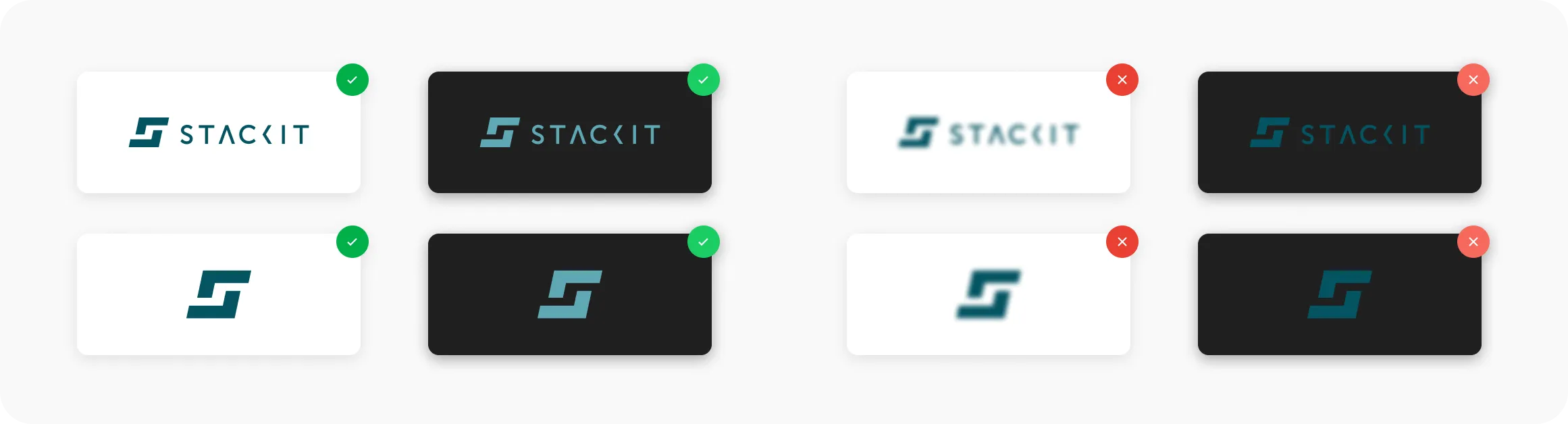
left - logos are clearly visible in all variants and designs, right - logos in low resolution or without high contrast are not clearly visible.
Screenshots and product images
Section titled “Screenshots and product images”- Use screenshots of the user interface and product images that visually represent the most important functions and typical use cases.
- Fewer but high-quality and meaningful images are better than many blurry or irrelevant images.
- Make sure that the screenshots and images are up-to-date and reflect the current version of your product.
- Pay attention to good lighting, image composition and sharpness. Professionally created images appear more trustworthy and appealing.
Product videos (optional, but highly recommended)
Section titled “Product videos (optional, but highly recommended)”- Demonstration videos: Create short, concise videos that show your product in action. Demonstrate the most important features and show typical use cases.
- Videos with satisfied customers talking about their experiences with your product are very convincing and create trust.
- Quality counts. Pay attention to good image and sound quality, a clear voiceover and an appealing design. A professionally produced video can significantly increase the conversion rate of your product page.
Documentation and support information
Section titled “Documentation and support information”Potential customers want to know that they will be well looked after the purchase and that they will receive support if they have any questions or problems. Comprehensive documentation and clear support information are therefore essential to build trust and allay concerns.
Product documentation
Section titled “Product documentation”- Ensure that comprehensive product documentation is available. This should include user manuals, FAQs, tutorials, instructions and possibly API documentation (depending on the product type and target group). You can link to the resources via your product detail page.
Support information
Section titled “Support information”- Clear information: Provide clear and easy to understand information about the support offered. What support channels are available? (e.g. email, telephone, live chat, support portal).
- Response times & SLAs: Communicate expected response times and defined service level agreements (SLAs).
- Contact information: Provide direct contact information to the support team (e.g. email address, phone number, link to support portal).
SEO optimization for marketplace searchability
Section titled “SEO optimization for marketplace searchability”Keyword research and integration
Section titled “Keyword research and integration”- Identify relevant keywords that potential customers use when searching for your product. Use keyword tools or analyze search terms from your target audience.
- Strategically integrate the most important keywords into your product name, short description, detailed description, feature list and tags. But don’t overdo it, the text should still be natural and readable.
Meta data and tags
Section titled “Meta data and tags”- Carefully fill in all available meta data fields in your product listing. This can include categories, industries, regions, compliance standards, etc.
- Use relevant tags (keywords) to further categorize your product and improve searchability.